Editorial
50th Mostra
Half a century
Milestones are dangerous because they create expectations, and oftentimes expectations are halfway to disappointment. However, we’re under the impression this won’t be the case with our 50th anniversary, as, for fear of falling short, we may have even gone a little overboard with the celebrations.
Mostra’s website used to be widely used for research, but, with time, technological changes made it impossible to connect the websites of the different editions. Because of that, over the past two years, we have been working to create a brand-new platform, which will once again allow consultations, with all our archives available to the public.
Much of our history, and the history of São Paulo and Brazil, can also be found in the exhibition “Tempo e Movimento: 50 anos da Mostra Internacional de Cinema em São Paulo” (Time and Movement: 50 Years of São Paulo International Film Festival), on view at Solar Fábio Prado. As part of the celebrations, we also launched the book “50 Anos, 50 Cartazes: A História dos Cartazes da Mostra Internacional de Cinema em São Paulo” (50 Years, 50 Posters: The History of the São Paulo International Film Festival Posters).
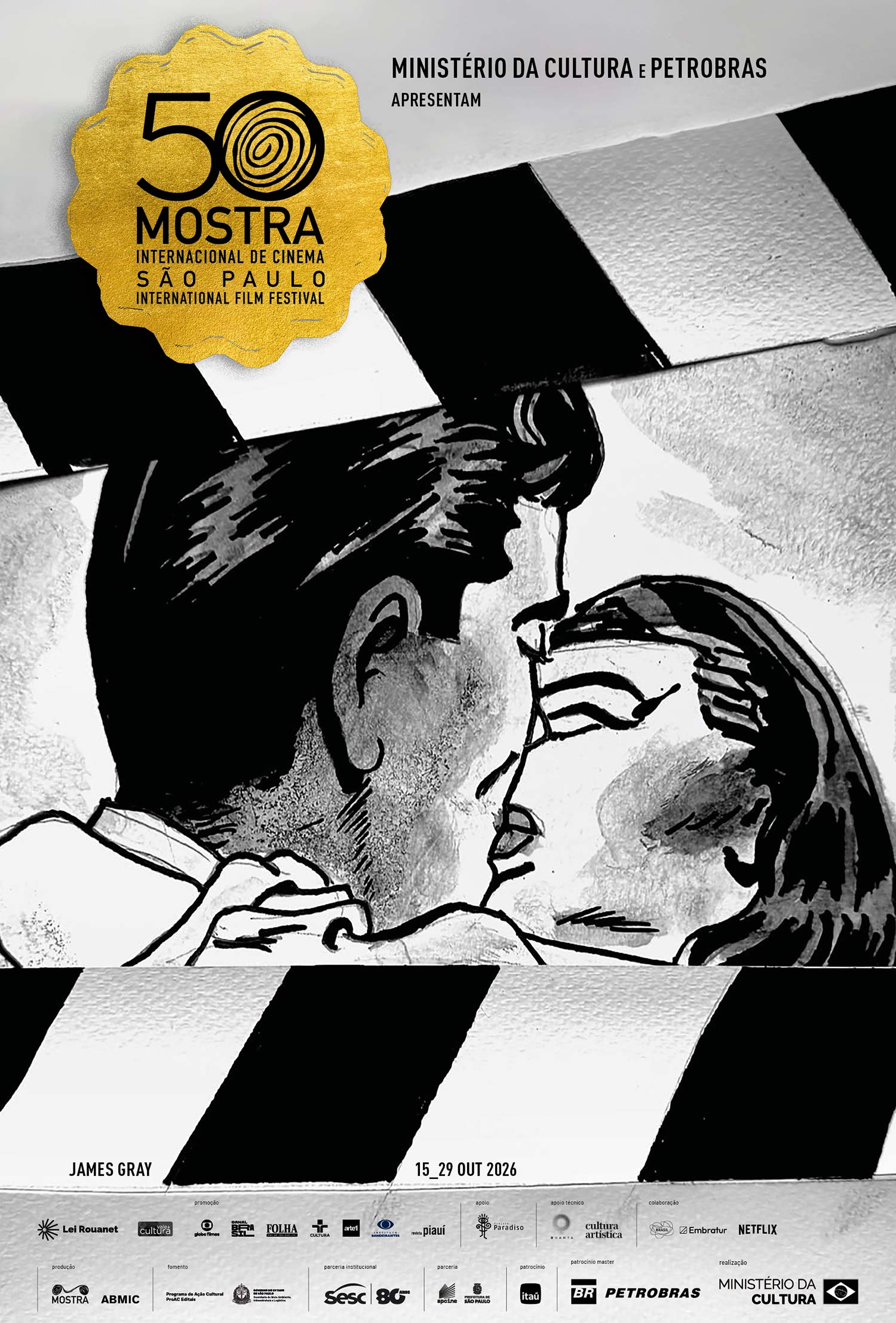
In this very special year, we kick off the edition with filmmaker James Gray and his “Paper Tiger”. Besides gifting us the artwork for our 50th Mostra poster, he will be in São Paulo to receive the Leon Cakoff Prize, and his work will be the subject of a retrospective.
Portuguese producer Paulo Branco, a tireless advocate for auteur cinema, will also be honoured with the Leon Cakoff Prize. With over 300 films under his belt, it will be Branco’s first time in São Paulo, where he’ll present a retrospective of his work and receive the award in person.
The third honoree of the Leon Cakoff Prize is Indian director, screenwriter and actor S. S. Rajamouli. The filmmaker “who made Bollywood look small”, according to the Indian press, will come to São Paulo to receive the award, present his mega-hit “RRR” (2022) and give a masterclass.
Italian-Chilean director Marco Bechis, meanwhile, is the recipient of the Humanity Award, and brings his latest film, “Back to Buenos Aires”. No stranger to São Paulo, he has previously been in the city to present powerful works that only reinforce this tribute, such as “Garage Olimpo” (1999) and “Birdwatchers” (2008).
The programme also includes “STEPS”, an exhibition of photographs by Iranian master Abbas Kiarostami, marking 10 years since his passing. Ahmad Kiarostami, his son, will take part in a discussion panel with Argentinian director Lisandro Alonso on the remake of “Taste of Cherry” (1997), one of Kiarostami’s masterpieces.
The 50th Mostra also offers newly restored copies of “The Battle of Chile” (1975–1979) and the rare “The First Year” (1972), in memory of one of the main voices in Latin American documentary filmmaking, who has also recently left us: Patricio Guzmán.
We also remember the centenary of Andrzej Wajda with screenings of restored copies of “Ashes and Diamonds” (1958), “The Birch Wood” (1970) and “Without Anesthesia” (1978). Likewise, we celebrate the Armenian master of montage Artavazd Pelechian through screenings of his newly restored body of work.
To affirm our commitment to the history of cinema, even our Mostra Series strand is presenting a restored work this year: Maurice Pialat’s miniseries “The House in the Woods” (1971). And to end this archival party on a high note, we will screen F. W. Murnau’s “Sunrise: A Song of Two Humans” (1927) with live music performed by the Brasil Jazz Sinfônica Orchestra.
But, to be sure, the 50th Mostra will not shy away from a broad panorama of contemporary cinema, bringing the latest works by directors well known to our audience, such as Hirokazu Kore-eda, Radu Jude, Tsai Ming-liang, Bruno Dumont, Jia Zhangke, Lisandro Alonso, Ruth Beckermann, Lav Diaz, Jonathan Glazer, Kiyoshi Kurosawa, Hong Sang-soo, Ali Asgari, Amos Gitai, Sandra Wollner, Sergei Loznitsa, Paweł Pawlikowski, Ryusuke Hamaguchi, Ulrike Ottinger and many others.
Among the most eagerly awaited titles are the prize-winners from major festivals, such as “Fjord”, by Cristian Mungiu, winner of this year’s Palme d’Or at Cannes; Andrey Zvyagintsev’s “Minotaur”, winner of the Grand Prix also at Cannes; “Woman Unknown”, by May el-Toukhy, recipient of the Golden Lion in Venice; and “Possible Love”, by director Lee Chang-dong, winner of the Grand Jury Prize at the same festival, as well as the winners from Rotterdam and Locarno. In addition to these, there are many other discoveries and works by new directors that are bound to surprise and enchant audiences.
The Audiovisual Ideas Market reaches its sixth year, consolidating its mission to promote discussions and critical thinking around pressing themes in the industry, alongside the already traditional Mostra’s Forum and Da Palavra à Imagem (From Word to Image), as well as Quase Lá, our work-in-progress section dedicated to Brazilian cinema.
Mostrinha, Mostra’s strand dedicated to children and young people, marks its third edition in a special way: this year’s poster depicts two kangaroos, characters created by cartoonist and writer Ziraldo (1932–2024), and will again offer screenings in all Unified Educational Centers (CEUs) of São Paulo, as well as other venues across the city.
Lastly, we renew our partnership with publisher Cosac with the book “Antes Que Eu Me Esqueça: Um Ensaio de Lembranças para os 50 Anos da Mostra Internacional de Cinema em São Paulo” (Before I Forget: An Essay of Memories for the 50 Years of the São Paulo International Film Festival). It is a personal account I allowed myself to write on an occasion that invites memories and reflection.
And, before I forget, I’d like to thank our sponsors and partners, who have made it possible to celebrate half a century of existence and, of course, the Mostra’s team, who can fix any oversight and, against all odds, has brought us this far.
Renata de Almeida


ABMIC - Associação Brasileira Mostra Internacional de Cinema © 2026 | Mostra de Cinema, Cultura e Eventos Ltda.